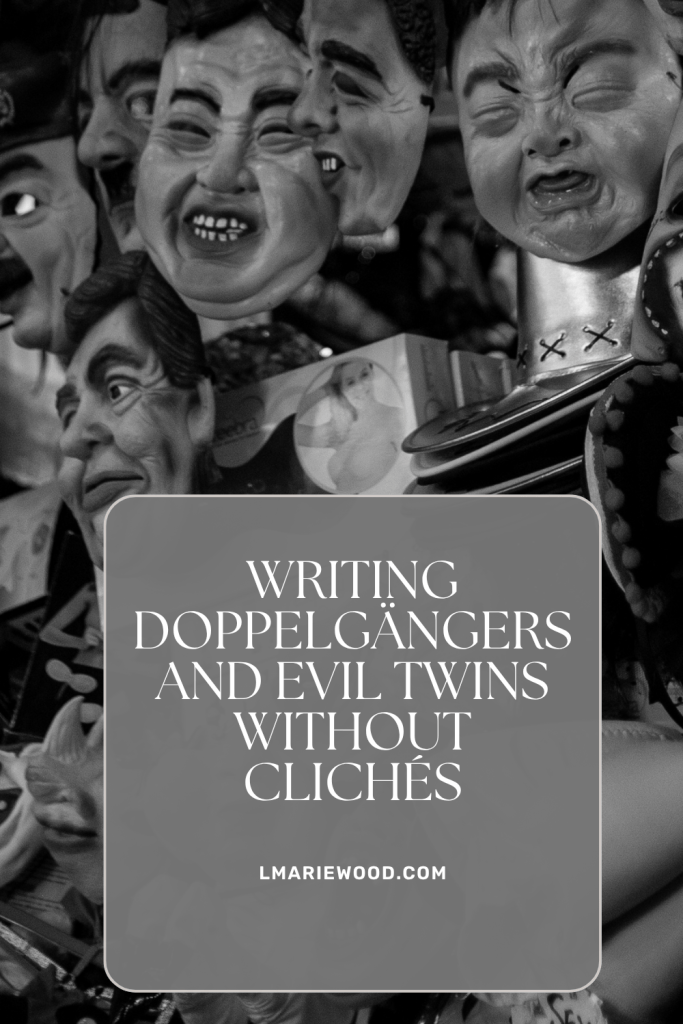
Few horror images are as instantly unsettling as seeing yourself where you should not be.
Your own face across a crowded train platform. Your own handwriting in a letter you never wrote. Your own voice answering the phone from inside your house. Your own reflection moving half a second late. Someone wearing your body better than you do.
The doppelgänger has survived in folklore, Gothic literature, psychological horror, supernatural fiction, thrillers, and modern media because it touches a fear that is both simple and profound: what if the self is not singular?
What if someone else can be you?
What if they are better at it?
What if they are the part of you that should have stayed hidden?
Doppelgängers and evil twins can easily become clichéd if they are treated as nothing more than “the good one” and “the bad one.” But when written with nuance, the double becomes one of horror’s richest tools for exploring identity, repression, envy, guilt, family trauma, social performance, and the terrifying instability of the self.
Understand Why the Double Scares Us
The double is frightening because it violates a basic assumption: that each person is unique, contained, and knowable.
A monster with claws threatens the body. A double threatens identity.
If someone looks like the protagonist, speaks like them, knows their memories, or imitates their mannerisms, the protagonist loses control of how they are seen. Their reputation becomes vulnerable. Their relationships become unstable. Their own sense of self begins to shake.
The double asks questions horror loves:
Are you who you think you are?
Would others know the difference?
What parts of you could be copied?
What parts of you are already a performance?
Those questions are much more interesting than simply making the double evil for evil’s sake.
Avoid the Flat “Good Twin, Bad Twin” Split
The most obvious version of the trope is also the easiest to weaken: one twin is pure, the other is wicked. One wears white, one wears black. One is sweet, one is murderous.
That can work in fairy-tale horror or deliberately stylized fiction, but if you want emotional depth, complicate the split.
Maybe the so-called good twin is passive, selfish, or cowardly in socially acceptable ways, while the “evil” twin acts out the family’s buried rage. Maybe the double is not morally worse, just freer. Maybe the protagonist envies the double’s confidence even while fearing their cruelty. Maybe the double exposes truths the protagonist worked hard to hide.
A strong double should not simply be opposite. They should be connected.
Ask what the double reveals.
If the protagonist is polite, the double may be honest to the point of violence.
If the protagonist is invisible, the double may demand attention.
If the protagonist is ashamed, the double may have no shame at all.
If the protagonist is beloved, the double may reveal how conditional that love really is.
Give the Double a Function in the Story
A doppelgänger should not appear only because doubles are creepy. The double needs a narrative and thematic job.
The double might replace the protagonist.
Expose the protagonist.
Punish the protagonist.
Tempt the protagonist.
Complete the protagonist.
Protect the protagonist in a monstrous way.
Force the protagonist to confront a lie.
Reveal that the protagonist has already been replaced.
The clearer the double’s function, the more focused the story becomes.
For example, a double in a domestic horror story might reveal how easily a family accepts appearances over truth. A double in a workplace thriller might explore ambition and replaceability. A double in a haunted house story might embody inherited trauma. A double in a psychological horror story might make the protagonist question their own memory and morality.
The double should intensify the story’s central fear.
Make the Similarities More Disturbing Than the Differences
Many writers focus on what makes the double different: colder eyes, strange smile, reversed scar, wrong-handedness. Those details can be effective, but the similarities are often scarier.
The double knows the protagonist’s childhood nickname.
The double orders the same coffee.
The double comforts the protagonist’s child with the exact song only the protagonist sings.
The double signs their name with the same hesitation before the last letter.
The double knows which floorboard creaks outside the bedroom.
These intimate details create dread because they suggest access. The double has not merely copied the surface. They have entered the private self.
Differences should be subtle and meaningful. Maybe the double does not blink enough. Maybe they remember things the protagonist has forgotten. Maybe they are left-handed only when lying. Maybe animals hate them. Maybe mirrors love them.
Use difference like a blade, not a costume.
Let Other Characters Make the Horror Worse
A doppelgänger story becomes much scarier when other people cannot tell the difference.
Or worse, when they prefer the double.
Imagine the protagonist’s spouse saying, “You seemed happier yesterday,” when yesterday was the double. Imagine a child running into the double’s arms. Imagine a boss promoting the double because they are more decisive. Imagine friends laughing at the double’s cruel jokes and calling the protagonist oversensitive.
Replacement horror depends on social recognition. We know who we are partly because others recognize us. When that recognition fails, the protagonist becomes isolated.
This is where the double can do real damage without lifting a weapon. They can ruin relationships, commit crimes, empty bank accounts, reveal secrets, seduce lovers, manipulate children, or make the protagonist look unstable.
The scariest double does not just steal a face. They steal a life.
Use the Double to Expose Performance
Every person performs identity to some degree. We behave differently with family, friends, strangers, employers, lovers, and enemies. A doppelgänger can turn that ordinary truth into horror.
What if the double performs the protagonist’s identity more successfully?
Maybe the protagonist has always felt like a fraud. The double arrives and becomes the better daughter, better wife, better employee, better artist, better victim, better monster. The protagonist watches others accept the improved version and begins to wonder whether they were ever necessary.
This kind of horror is emotionally brutal because it touches envy and insecurity.
The double becomes a mirror that says, “You are replaceable.”
Think Beyond the Supernatural
Doppelgängers can be ghosts, demons, omens, shapeshifters, clones, hallucinations, alternate selves, twins, impostors, AI replicas, magical fetches, or psychological projections. The trope is flexible.
You do not have to choose the most obvious explanation.
In a folk horror story, the double may be a death omen.
In a science fiction horror story, it may be a biological copy.
In a domestic thriller, it may be an actual twin raised elsewhere.
In a psychological horror story, it may be uncertain whether the double exists.
In a supernatural mystery, the double may be a spirit wearing a living face.
What matters is not the mechanism alone. What matters is how the double destabilizes identity.
Make the Evil Twin Human
If you are writing an actual twin rather than a supernatural double, avoid making one twin evil simply because the plot needs a villain.
Twins are people, not symbols by default. If one becomes dangerous, give that danger roots. Family dynamics, comparison, favoritism, inheritance, resentment, shared trauma, secrecy, competition, or codependence can all create believable tension.
Maybe the family treated one twin as the miracle and the other as the mistake. Maybe one twin was forced to protect the other. Maybe they were constantly compared until love became rivalry. Maybe one twin knows a secret the other built their life on. Maybe their identities were blurred by everyone around them until one committed a terrible act just to become separate.
The horror of twin stories often comes from intimacy. These characters may know each other too well. They may share gestures, memories, wounds, and private language. Betrayal between them can feel almost like self-harm.
Use Mirrors, Reflections, and Photos With Purpose
Doppelgänger stories naturally invite mirrors, but mirrors can become clichéd if used without purpose. The reflection that moves on its own has been done many times. To make it fresh, connect the mirror imagery to the character’s fear.
A vain character may see the double aging in the mirror.
A grieving character may see the double standing with the dead.
A liar may see the reflection speaking the truth.
A lonely character may become comforted by the reflection before fearing it.
Photos can also be chilling. The double appears in old family albums. Security footage shows the protagonist entering a room they never visited. A child draws two mothers. A passport photo changes expression.
These objects should do more than signal “creepy double.” They should reveal the double’s relationship to time, memory, family, or identity.
Let the Protagonist Become Unreliable to Themselves
Doppelgänger horror often overlaps with paranoia. The protagonist may not be believed, but the deeper terror is that they may stop believing themselves.
Did they see the double, or are they dissociating?
Did the double commit the crime, or did they?
Are the memories false?
Why does the double know things the protagonist never told anyone?
Why does the protagonist begin remembering the double’s actions from the inside?
This uncertainty can create powerful psychological suspense. However, be careful not to treat mental illness as a cheap twist. The goal is not “the protagonist was crazy all along.” The goal is to explore instability, fear, and identity with respect and intention.
A good unreliable-self story should feel emotionally true even if the supernatural truth remains uncertain.
Give the Double Limits
An all-powerful double can become boring. Limits create suspense.
Maybe the double can imitate appearance but not memory. Maybe it cannot enter a home unless invited as the protagonist. Maybe it only appears in reflective surfaces at first. Maybe it grows stronger when someone mistakes it for the real person. Maybe it cannot lie, which makes its truths dangerous. Maybe it can copy everyone except the protagonist’s scars.
Limits help shape the plot. They give the protagonist something to discover, exploit, or misunderstand.
They also make the double feel less random. Horror becomes more satisfying when the threat has patterns.
Consider the Ending Carefully
Doppelgänger stories need endings that honor the identity crisis they create.
The protagonist may defeat the double, but feel changed by what it revealed.
The double may replace the protagonist completely.
The two may merge.
The protagonist may realize they were the double.
The family may choose the false version.
The double may die, leaving the protagonist free but grieving.
The protagonist may kill the double and discover that everyone else still sees the double when they look at them.
The ending should not only resolve the plot. It should answer, complicate, or deepen the story’s question about selfhood.
If your story asks, “Can anyone truly know me?” the ending should touch recognition. If it asks, “Am I replaceable?” the ending should test value. If it asks, “What part of myself have I rejected?” the ending may require confrontation rather than simple victory.
The Double Is Not Just a Monster
Doppelgängers and evil twins become clichéd when they are treated as costume pieces: same face, darker personality, predictable showdown.
They become powerful when they are written as intimate threats.
A good double does not only endanger the protagonist’s life. It endangers their name, history, relationships, morality, and sense of reality. It reveals what the protagonist fears about themselves. It asks whether identity is something internal, something performed, something witnessed, or something that can be stolen.
The scariest double is not the one that looks wrong.
It is the one that looks right.
Sources:
Evil Twins and Doppelgangers: What Meaning Does the Double Have in Folklore?
Doppelgangers and Curious Myths and Stories of Spirit Doubles
History of the Double Doppelganger
Remember You Are One: The Prevalence of Doppelgängers in Horror

