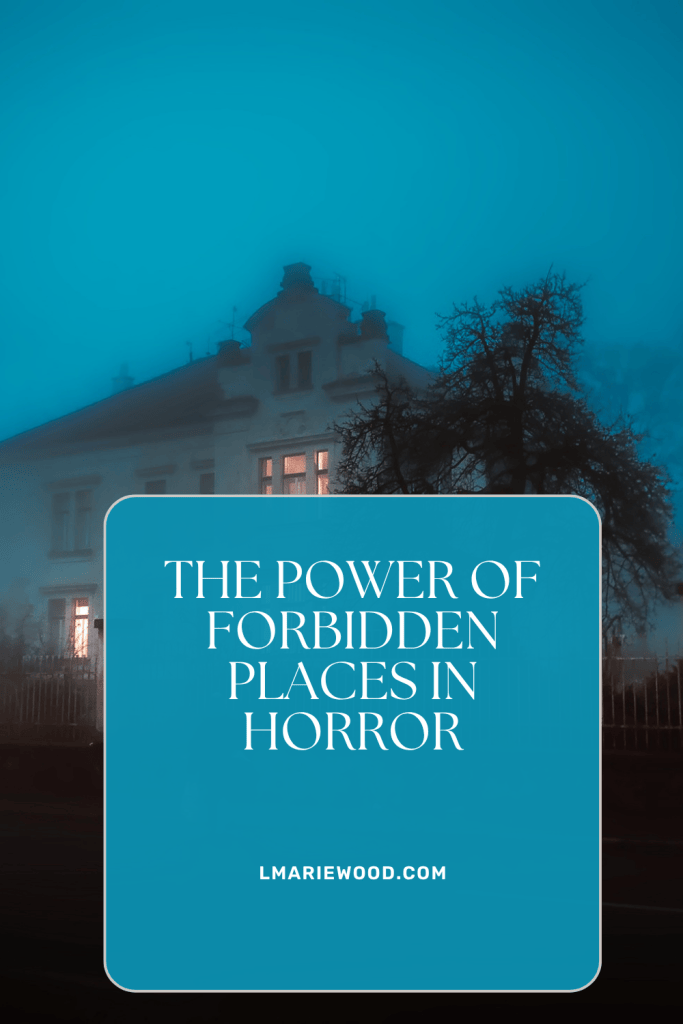
Every good horror story has at least one place the characters should not go. Sometimes everyone knows it. The locals avoid the abandoned church on the hill. Children dare one another to touch the gate of the burned asylum. The family never opens the attic door. No one crosses the creek after dark, and the old road is missing from every map even though everyone in town seems to know where it leads.
Other times, the forbidden place looks perfectly ordinary. It might be a guest room, basement, field, nursery, hallway, storage unit, or locked office at the end of a school corridor. What makes it frightening is not necessarily its appearance. What matters is the strange weight people give it and what they refuse to say when someone asks about it.
Forbidden places are powerful in horror because they create instant tension. The moment a story tells readers, “Do not go there,” they naturally want to know why. The warning becomes an invitation, the boundary becomes a promise, and the locked door becomes a question with teeth. Of course, horror being horror, sooner or later someone is going to cross that line.
Why Forbidden Places Work So Well
A forbidden place gives horror a natural engine because it creates curiosity, dread, temptation, and danger simultaneously. Readers understand rules, and they understand the peculiar anxiety of being told not to look, touch, ask, or enter. Once a boundary has been established, the story immediately creates a dramatic question: what happens if someone disobeys?
That question is older than modern horror. It appears in folklore, fairy tales, Gothic fiction, religious stories, ghost stories, urban legends, and campfire tales. The forbidden room, cursed forest, sealed crypt, haunted road, sacred grove, abandoned building, and island no one visits all contain the same basic promise: there is a boundary between safety and danger, and crossing it will have consequences.
The protagonist may not know the full history of the place, but the reader can sense the weight of the taboo. That is where the dread begins—not necessarily with a monster, but with the knowledge that someone, somewhere, decided this place should not be entered. Even more unsettling is the possibility that the rule exists because someone entered before.
Make the Warning Specific
A vague warning can be effective, but a specific warning usually creates far more intrigue. “Don’t go into the woods” is familiar enough that readers may barely notice it. “Don’t go into the woods after the church bell rings” immediately raises questions.
Take it one step further: “Don’t go into the woods after the church bell rings, and if you hear your mother calling from the trees, do not answer her.” Now the warning implies history. Something happened that taught people not only to fear those woods but to fear a particular event inside them.
Why the church bell? Why does the voice sound like the listener’s mother? What happened to the person who answered?
Specific rules invite readers to start building theories before the characters have answers. The warning should provide shape without full clarity, giving readers enough information to recognize that a danger exists without telling them exactly what it is.
You might warn characters never to sleep in the blue room or photograph the old well. Perhaps no one enters the orchard during the harvest moon, the basement light must remain on all night, or the west stairwell is supposedly reserved for staff even though no staff members work there anymore. Maybe the strangest rule is the simplest: never count the windows from outside the house.
The more unusual the warning, the more readers will want to understand why it exists.
Give the Place a Public Story and a Private Truth
Forbidden places often work best when they have two histories: the story people tell publicly and the truth hiding underneath it.
The official explanation may sound completely reasonable. The mine collapsed years ago. The school closed after a fire. The family chapel is structurally unsafe. The old house belongs to no one. The island is protected land. The abandoned hospital wing contains asbestos, and the old mountain road washed out decades ago.
Some of these explanations might even be true. Horror thrives, however, in the gap between a reasonable explanation and unreasonable behavior. If the mine simply collapsed, why do people still hear singing from below? If the school burned down, who keeps leaving fresh chalk marks on the remaining blackboard?
Maybe the family chapel really is unsafe, but that does not explain why the priest leaves flowers outside its door every winter. Perhaps the island genuinely is protected land, but why are there no birds anywhere near it? The public explanation gives characters permission to dismiss the warning, while the private truth gives the story its depth.
This approach also makes the people surrounding the forbidden place more interesting. They do not necessarily need to be lying outright. They may have repeated the harmless explanation for so long that no one remembers who invented it, or they may know only fragments of what really happened.
Let the Place Change Behavior Before It Shows Its Teeth
A forbidden place should affect characters before the obvious scare arrives. People may lower their voices whenever it is mentioned or refuse to give directions to outsiders. Dogs might stop at the property line, while a child begins sleepwalking toward the locked gate every night.
The protagonist might experience something even subtler. Perhaps they feel inexplicable shame whenever they stand near the door. Their phone loses its signal only in that hallway, or they suddenly remember something that never happened to them. None of these events needs to reveal the threat yet. Their purpose is to show that the forbidden place already has influence.
The place does not need to roar to become frightening. It can exert pressure quietly. It can attract some people and repel others, encourage lies, erase memories, or push families into repeating mistakes they thought ended generations ago.
A great forbidden place should feel as though it has gravity. Characters may spend half the story insisting they want nothing to do with it while their lives slowly begin orbiting it.
Use Desire as the Key
Characters should not enter forbidden places simply because the plot needs them to make a bad decision. They need a reason powerful enough to overcome their fear.
Curiosity can certainly work, especially with children, teenagers, investigators, or outsiders who do not understand local warnings. Stronger emotional motives, however, often create richer horror because readers understand why the character takes the risk.
Someone may enter because a loved one disappeared inside. A historian might believe hidden records could restore a stolen legacy, while a grieving mother hears her dead child singing beyond a locked door. A broke contractor may accept a dangerous renovation because the owner is paying an impossible amount of money. A witch might cross into a forbidden grove because it contains the only known cure for someone she loves.
A journalist may know perfectly well that the abandoned building is dangerous and enter anyway because exposing what happened there matters more than personal safety. These characters are not simply foolish. They want something recognizable and human.
That distinction matters because forbidden places often work best when they exploit need. The place does not necessarily call to random strangers. It calls to the wound.
Let Architecture Create Dread
Forbidden places are often frightening because of how they are built, arranged, or decayed. Architecture can tell readers what kind of fear they should feel before anything supernatural occurs.
Narrow halls create confinement. Empty malls evoke abandonment and wrong familiarity. Crumbling churches can suggest corrupted faith, while windowless rooms hint at secrecy. Long hospital corridors can evoke helplessness, and old family homes naturally carry associations with inheritance, memory, and buried guilt.
Liminal spaces can be especially effective because they are almost normal. Empty corridors, fluorescent rooms, abandoned offices, deserted schools, dead malls, and spaces that seem designed for transition become unsettling when there is nowhere to transition to. Familiarity remains, but the human purpose of the space has disappeared.
The key is not to describe every architectural detail. Choose features that create emotional pressure. A ceiling might be slightly too low, while the hallway seems to turn left too many times. Perhaps the wallpaper resembles hundreds of closed eyes when viewed from a distance, or every room inexplicably contains a drain in the center of the floor.
Maybe the nursery has a perfectly ordinary door—until the character enters and discovers there is no handle on the inside. The architecture should feel designed, even if readers do not yet know who designed it or what purpose it serves.
Make the Place Reflect the Story’s Theme
Forbidden places become much stronger when they connect directly to the story’s deeper concerns. The setting should not feel as though it could be swapped for another spooky location without changing anything.
If the story explores family denial, the forbidden place might be an attic, cellar, nursery, or sealed bedroom containing the evidence everyone agreed to forget. A story about community complicity might center on a town hall, church, school, or festival ground where respectable traditions conceal something terrible.
A story about grief might make a cemetery, hospital wing, lake, or dead child’s bedroom forbidden. If the central theme involves ambition, the dangerous place could be a laboratory, archive, theater, or executive floor where people crossed ethical boundaries in pursuit of success. A story about forbidden knowledge practically begs for a library, observatory, crypt, laboratory, or scholar’s private study.
The setting should belong to this protagonist and this particular story. When the connection is strong enough, the forbidden place becomes more than scenery. It becomes a physical manifestation of the thing the characters have refused to confront.
Decide What the Place Wants
Not every forbidden place needs to be literally alive, but it can help the writer to imagine that it is and ask a simple question: what does this place want?
Perhaps it wants to keep something inside rather than keeping trespassers out. Maybe it wants to lure people through the door, preserve something from the past, attract witnesses, or collect replacements for people who disappeared long ago. It may demand blood, memory, worship, secrecy, silence, or simply recognition.
You can also ask whether it punishes those who enter or those who attempt to leave. Those are two very different kinds of horror. A place that violently rejects trespassers feels different from one that welcomes everyone warmly and then refuses to let them go.
Even if the setting is not conscious, thinking about its apparent purpose can help shape the atmosphere and plot. A sealed crypt intended to contain a monster will feel different from a house constantly seeking new occupants. A sacred grove that punishes disrespect will create different rules than an abandoned mall that somehow mimics the desires of anyone who enters.
When a forbidden place appears to have a purpose, readers begin to sense intention behind the fear.
Use Thresholds
The moment a character crosses into a forbidden place should matter because thresholds mark transitions. A gate, bridge, creek, door, elevator, tunnel mouth, property line, broken fence, or stairway descending underground can serve as the dividing line between the familiar world and whatever waits beyond it.
Give the character a moment to feel that decision. This does not require melodrama. Something as simple as a sudden temperature drop can be enough. The birds may stop singing, the phone may lose its signal, or the character’s companion may walk all the way to the boundary and then refuse to take another step.
Perhaps an old childhood rhyme suddenly comes back to the protagonist after decades of being forgotten. Maybe the rusty latch everyone warned them about opens far too easily, as though someone on the other side has already unlocked it.
Crossing the threshold can feel like consent, violation, or doom depending on the story. The important thing is that the character understands, at least on some level, that they are making a choice. Once they cross, the rules can change.
Reveal the Cost of Trespass
A forbidden place must eventually punish, transform, or demand something from the character. Otherwise, the warnings surrounding it become empty.
The cost can be physical, including injury, infection, entrapment, or death. It can be psychological, leaving the character with memory loss, obsession, paranoia, or an inability to trust their own senses. Social consequences can be equally devastating if entering the place leads to exile, disbelief, betrayal, or accusation.
The cost may also be supernatural or spiritual. A character could leave possessed, cursed, contaminated, or bound by a vow they never knowingly made. In stories dealing with families and inherited horror, the cost might not even fall entirely on the trespasser. The character may awaken something that attaches itself to their children or future descendants.
Whatever form it takes, entry should matter. If a character wanders into the forbidden place, experiences something creepy, and then returns to normal life unchanged, the setting may ultimately feel less powerful than the buildup promised.
Instead, let the place mark them. They may bring something out without realizing it, or discover that something followed them home. Perhaps the final horror is realizing that everyone misunderstood the warning from the beginning: the danger was never that people could not escape.
They were never supposed to leave.
Do Not Overexplain the Place
Forbidden places lose some of their power when every mystery is neatly cataloged and explained. Readers may need answers, particularly if the forbidden place is central to the plot, but answers do not require eliminating every shadow.
The reader may learn why the town avoided the chapel, why the family locked the room, or what happened to the people who vanished along the forest path. That does not mean they need a complete history explaining every strange event that has ever occurred there.
A place can have history without being fully understood. Old records might confirm that people disappeared there without revealing where they went. The family may know that a particular room must remain locked even though no one alive remembers who built it. An annual ritual may genuinely protect the village, while no one knows whether human beings invented the ritual or something else taught it to them.
That uncertainty preserves the scale of the horror. The characters can understand enough to survive—or enough to realize they are in danger—without reducing the forbidden place to a tidy collection of facts.
Some doors become less frightening once we know exactly what is behind them. Others are frightening precisely because we know just enough.
The Door Is Never Just a Door
Forbidden places work because they combine curiosity with dread. They establish a boundary and then make that boundary irresistible. They contain warnings, history, temptation, secrets, and consequences, all before the protagonist ever takes the first step inside.
To write them effectively, create warnings specific enough to inspire questions. Give the location a public history and a private truth. Let it influence people before revealing its danger, connect it to something the protagonist genuinely wants, and make the architecture reinforce the story’s emotional themes. Most importantly, crossing the threshold should have consequences.
The scariest forbidden places do not simply hide monsters behind locked doors. They make readers wonder who locked the door in the first place, what happened to make the warning necessary, and why everyone who knows the truth is still too frightened to look.
Sources:
‘I found a place’: how Backrooms captures the horror of sinister architecture
The Psychology, Geography, and Architecture of Horror: How Places Creep Us Out
A Fear of the Folk: On Topophobia and the Horror of Rural Landscapes

