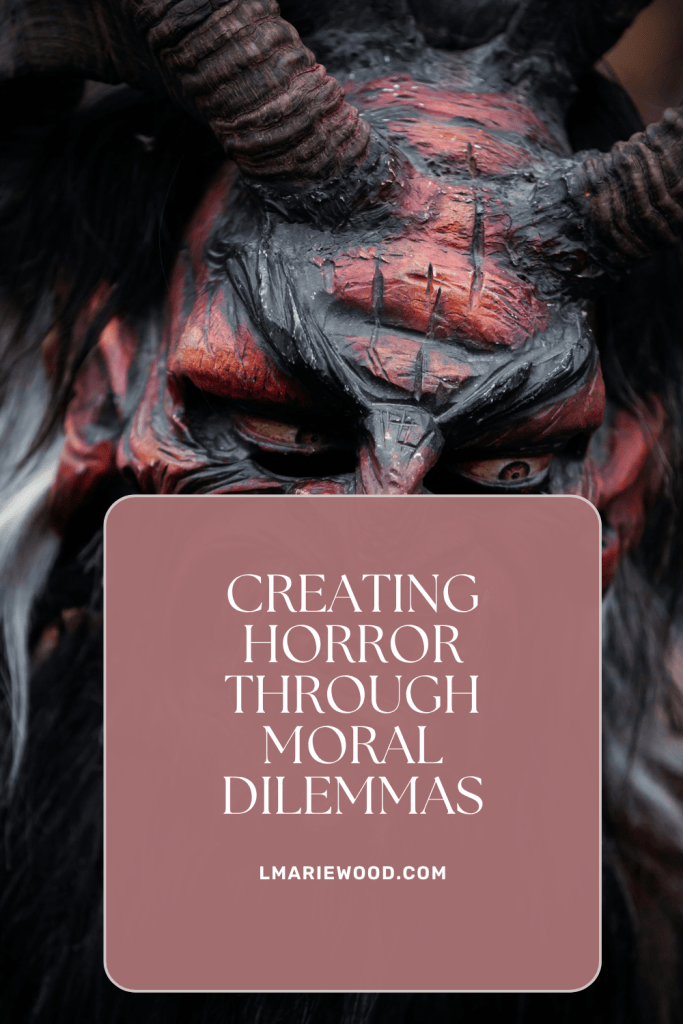
The creature beneath the hospital has made its demands clear. Every night, one patient must be sent downstairs. If the staff refuse, the creature will leave its chamber and kill everyone in the building.
For three nights, the hospital administrator has complied. She tells herself she is saving hundreds of lives, even as she signs the transfer orders and watches the patients disappear.
On the fourth night, the creature requests her son.
The administrator has spent the entire story believing that sacrificing one person to protect many is a terrible but necessary decision. Now she must confront what that belief actually means when the person selected is someone she loves.
Moral dilemmas can make horror particularly disturbing because they threaten something beyond physical safety. They force characters to choose between competing values, knowing that every available option carries consequences.
A monster may threaten a protagonist’s life, but a moral dilemma threatens their understanding of who they are. Surviving the encounter may require betraying a friend, sacrificing an innocent person, abandoning a cherished principle, or accepting responsibility for a terrible outcome.
When handled effectively, these choices create a kind of horror that continues long after the immediate danger has passed.
What Makes a Moral Dilemma Frightening?
A moral dilemma occurs when a character must choose between conflicting obligations, values, or outcomes, and no available option is entirely satisfactory.
The key is genuine conflict. If one choice is obviously harmless and the other is clearly cruel, the situation may reveal character, but it does not necessarily create a difficult moral decision.
Suppose a protagonist discovers that a stranger is trapped inside a burning building. Choosing whether to help involves risk, but readers may still regard rescue as the obvious moral choice.
Now imagine that entering the building means leaving the protagonist’s young child alone outside while something dangerous approaches. The character wants to save the stranger, but doing so may expose someone they love to harm.
The dilemma becomes more complicated because both obligations matter.
Horror intensifies these conflicts by introducing extraordinary circumstances, limited information, supernatural rules, and severe consequences. Characters may have to make decisions quickly while frightened, exhausted, or uncertain about whether they fully understand the danger.
The most effective moral dilemmas do not simply ask whether a character is willing to do something terrible. They ask what the character is willing to sacrifice to avoid doing it.
Begin With the Character’s Values
A moral dilemma becomes meaningful when readers understand the protagonist’s beliefs before those beliefs are challenged.
A physician may value the preservation of life above almost everything else. A parent may believe their first responsibility is protecting their children. A police officer may be committed to following the law, while a journalist may believe that exposing the truth is worth almost any personal cost.
These values provide the foundation for later conflict.
If a physician encounters a supernatural entity that can be contained only by allowing one person to die, the dilemma directly challenges their professional and personal commitments. If a journalist discovers that publishing the truth will release a dangerous force, the story tests whether truth remains an absolute good when revealing it causes harm.
The conflict becomes especially powerful when the character has previously expressed certainty about the principle being challenged.
A protagonist who insists that they would never abandon another person may eventually face a situation in which remaining means condemning an entire group. Their earlier confidence gives the later decision emotional weight.
Readers are not merely watching someone choose between two unpleasant outcomes. They are watching a person discover whether their values can survive circumstances they never imagined.
Make Both Choices Carry a Real Cost
A weak moral dilemma often contains an easy escape disguised as a difficult decision. The protagonist appears to face two terrible options, but a convenient third solution emerges before they must accept either consequence.
There is nothing wrong with characters searching for alternatives. Intelligent protagonists should question the terms of a dilemma rather than automatically accepting whatever an antagonist demands.
However, if every difficult choice disappears through coincidence or last-minute intervention, readers may stop believing the story will hold its characters accountable.
Consider a mother who learns that destroying a cursed object will free her daughter but permanently trap another child inside the supernatural realm. She might search for a way to save both children, and that investigation can become an important part of the plot.
The dilemma remains powerful if the search fails or produces another difficult option. Perhaps she can save both children only by entering the realm herself, knowing she may never return.
The alternatives can evolve, but they should not become effortless.
A compelling moral dilemma leaves the character with a meaningful cost regardless of the choice they make. The nature of that cost should connect to the character’s values and relationships rather than functioning as an arbitrary punishment.
Make the Choices Personally Significant
Large-scale consequences can create urgency, but personal consequences often produce stronger emotional involvement.
A character deciding whether to sacrifice one stranger to save a hundred people faces a serious moral question. The situation becomes more emotionally complicated when the stranger is a former friend, a family member, or someone the protagonist previously wronged.
Personal connections should not exist solely to manipulate readers. They need to be established through the story so the dilemma feels like a natural collision between relationships and circumstances.
Imagine a woman who has spent years trying to reconcile with her estranged sister. When a supernatural threat forces her to choose between protecting her sister and saving the community that raised them, both options threaten something important.
Saving her sister might condemn people who have shown her kindness. Saving the community might destroy the relationship she has worked so hard to repair.
The choice matters because readers understand the emotional history surrounding it.
Personal stakes also create consequences beyond the immediate decision. Even if the protagonist survives, they may have to live with damaged relationships, guilt, resentment, or the knowledge that someone else paid the price for their survival.
Let the Horror Create the Dilemma Naturally
Moral dilemmas are most effective when they emerge from the established rules of the story rather than appearing as artificial tests designed by the author.
A haunted house might require its occupants to confess a secret before allowing them to leave. A supernatural creature might feed on lies, forcing characters to choose between revealing painful truths and strengthening the entity. A cursed town might remain safe only while its residents continue an inherited ritual that harms outsiders.
These circumstances generate moral conflict through the mechanics of the horror itself.
The writer should understand why the dilemma exists. If a monster demands sacrifices, consider what those sacrifices accomplish within the story’s supernatural logic. If a ritual requires betrayal, determine how that requirement connects to the curse’s history or theme.
Readers do not necessarily need every detail explained, but the rules should feel consistent enough for the choices to matter.
Arbitrary dilemmas can become frustrating because characters appear to be suffering through situations that exist only to force dramatic decisions. A coherent supernatural system makes the conflict feel like an unavoidable consequence of the world the writer has created.
Use Conflicting Loyalties
Loyalty is a particularly effective source of moral horror because it can make otherwise admirable qualities dangerous.
A character may be loyal to family, friends, community, profession, faith, or a personal promise. Problems arise when those loyalties demand incompatible actions.
Suppose a small town has protected itself from a supernatural threat for generations by concealing the truth from outsiders. The protagonist discovers that their family has helped maintain the deception and that innocent travelers have suffered because of it.
Exposing the truth might end the harm, but it could also destroy the community and place the protagonist’s relatives in danger.
The character must decide whether loyalty means protecting loved ones from consequences or holding them accountable for what they have done.
This kind of conflict works because both sides can contain understandable motivations. The family may genuinely believe they are preventing a greater disaster, while the protagonist recognizes that their protection has depended on sacrificing people who never consented.
The horror grows from the realization that loyalty and morality do not always point in the same direction.
Make the Character Responsible for the Outcome
Moral dilemmas lose some of their force when characters have no meaningful agency. If a protagonist is physically compelled to commit an act and has no possibility of resisting, the situation may be terrifying, but it functions more as coercion than a moral choice.
A strong dilemma usually requires the protagonist to participate in the decision, even under extreme pressure.
They may have limited information, inadequate time, or terrible options, but their response should reveal something about their priorities.
A scientist who discovers that a containment system is failing might choose to seal a laboratory while colleagues remain inside. The decision could prevent a deadly organism from escaping, but the scientist must knowingly condemn people they have worked beside for years.
The story becomes more complex if the scientist previously ignored safety warnings that contributed to the disaster.
Now the decision involves not only competing lives but personal responsibility. The protagonist must confront the possibility that their earlier choices helped create the situation they are trying to resolve.
That connection between past action and present consequence can make moral horror especially powerful.
Use Limited Information Carefully
Characters rarely make decisions with complete knowledge, particularly in horror stories where supernatural forces may deceive them.
Uncertainty can intensify a moral dilemma because the protagonist cannot be certain that the sacrifice they are considering will accomplish what they hope.
Perhaps a demon claims that surrendering one person will save everyone else. The protagonist has evidence that the creature possesses extraordinary power, but no proof that it intends to honor the bargain.
The character must weigh the danger of refusing against the possibility that compliance will only strengthen the threat.
This uncertainty should be handled fairly. If the writer withholds information that the protagonist would reasonably possess simply to manufacture a difficult decision, readers may feel manipulated.
Instead, establish the limits of what the character can know. Perhaps the only surviving witness is unreliable, the relevant records are incomplete, or the supernatural entity has demonstrated that it can imitate trusted voices.
The protagonist’s uncertainty then becomes part of the story’s danger rather than a convenient excuse for the plot.
Allow the Protagonist to Search for Another Way
Characters facing impossible choices should not automatically accept the options presented to them. Their attempts to escape the dilemma can reveal courage, ingenuity, desperation, and the limits of their moral convictions.
A protagonist might bargain with the antagonist, investigate the supernatural rules, recruit allies, or offer themselves as a substitute for someone else.
These efforts can produce new discoveries and complications.
Suppose a character learns that a cursed village requires one person to remain behind each winter. Rather than choosing a victim, they investigate the origin of the curse and discover that the original agreement was made under false pretenses.
This revelation might offer a way to challenge the bargain, but breaking it could release the force the agreement was designed to contain.
The dilemma has evolved rather than disappeared.
Allowing characters to resist the terms of a moral choice also prevents the story from becoming unnecessarily fatalistic. Their determination to find another solution can be admirable even when the final outcome remains tragic.
Let Good Intentions Produce Terrible Consequences
Some of the most disturbing moral horror begins with a character trying to do the right thing.
A protagonist may conceal a dangerous truth to prevent panic, only to discover that secrecy allows the threat to spread. Someone might rescue an apparently innocent stranger and unknowingly bring a supernatural predator into a protected community.
These situations challenge the assumption that good intentions guarantee good outcomes.
The consequences should arise from the character’s decision in a believable way. A compassionate action can become tragic when the protagonist overlooks a warning, misunderstands the threat, or prioritizes one obligation over another.
This does not mean the story should punish kindness indiscriminately. If every compassionate decision leads to disaster, readers may conclude that the fictional world operates according to arbitrary cruelty.
The stronger approach is to make the consequences specific to the circumstances. The protagonist’s decision may have been reasonable with the information available, yet still produce harm that cannot easily be undone.
That tension between intention and outcome creates opportunities for guilt, conflict, and meaningful character development.
Explore the Difference Between Survival and Innocence
Survival is one of horror fiction’s most familiar goals, but moral dilemmas can complicate what survival means.
A protagonist may escape physical danger only by betraying someone else. Another might survive because they remained silent while an innocent person was blamed. A character may discover that the only way to remain alive is to continue participating in a ritual they find abhorrent.
These situations create a distinction between staying alive and remaining morally unchanged.
The protagonist might achieve the practical goal of survival while losing something essential to their identity. They may become isolated from people they love or unable to justify their actions to themselves.
This can create an especially unsettling ending. The monster is defeated, the protagonist escapes, and the immediate danger has ended, but the consequences of their choices remain.
Readers are left considering whether survival was truly a victory and what the character will have to live with afterward.
Give Supporting Characters Their Own Moral Positions
A moral dilemma becomes richer when other characters have believable opinions about the choices involved.
One character may believe that protecting the greatest number of people is always the priority. Another may refuse to sacrifice an innocent person under any circumstances. Someone else may argue that loyalty to family outweighs obligations to strangers.
These disagreements can create tension even before the supernatural threat reaches its most dangerous stage.
Imagine a group trapped in a remote research station where one member may be carrying a dangerous entity. Some want to isolate the suspected person immediately. Others believe there is insufficient evidence and that isolation would be cruel.
The conflict is not simply between sensible characters and foolish ones. Both groups have legitimate concerns, and the situation becomes more difficult because they value different kinds of safety.
Supporting characters can also expose the protagonist’s contradictions. Someone who claims to value every life equally may behave differently when a loved one is threatened. Another character can challenge that inconsistency, forcing the protagonist to confront beliefs they would rather leave unexamined.
Avoid Turning Moral Horror Into a Lecture
Stories built around ethical questions can become heavy-handed when the writer repeatedly explains which choices are right and which are wrong.
Readers generally respond more strongly when the conflict is dramatized through action, dialogue, and consequences. Rather than having characters deliver lengthy speeches about the value of human life, place them in situations where those beliefs influence difficult decisions.
A character who refuses to abandon an injured stranger demonstrates a moral commitment through behavior. If that decision later places the group in danger, readers can consider the consequences without being told what conclusion to reach.
Ambiguity can be valuable, but it should not become confusion. Readers need to understand the available choices and their likely consequences even when they disagree about which option is preferable.
The writer does not have to declare a universal moral answer. A compelling horror story can present a difficult situation, explore its consequences, and allow readers to wrestle with the questions afterward.
Let the Choice Change the Character
A major moral dilemma should have consequences for the protagonist’s development.
Someone who sacrifices their own safety to protect another person may discover a capacity for courage they previously doubted. A character who betrays a friend to survive may become increasingly willing to justify similar betrayals.
The decision can reinforce existing values, expose hypocrisy, or begin a transformation that continues throughout the story.
A protagonist who once believed that rules must always be followed might discover that obedience can enable cruelty. Another who considered themselves compassionate may learn that their compassion disappears when helping someone becomes personally costly.
These realizations should influence later behavior.
If the protagonist makes a devastating decision and then returns to their previous personality without reflection or consequence, the moral conflict may feel superficial. The story should remember what the character chose, just as the character must remember it.
Build the Climax Around the Hardest Choice
A moral dilemma can provide the emotional foundation for a horror climax because it forces the protagonist to confront the story’s central conflict through action.
Earlier choices may have tested smaller versions of the same values. The climax then presents a decision that combines the protagonist’s deepest fears, strongest loyalties, and most painful vulnerabilities.
Consider a character who has spent the novel protecting a sibling from a supernatural curse. At the climax, they discover that transferring the curse to an innocent stranger would save the sibling permanently.
The choice forces the protagonist to decide whether love justifies deliberately harming someone who has done nothing wrong.
The supernatural threat remains important, but the emotional climax depends on the character’s response to the dilemma.
Whatever the protagonist chooses, the consequences should feel consistent with the story’s established rules and character development. An ending that avoids every cost through a convenient revelation may undermine the conflict readers have been anticipating.
Let the Consequences Outlive the Monster
A moral dilemma does not necessarily end when the supernatural threat disappears. The protagonist may have survived, but the choices they made can continue affecting their relationships and sense of self.
A character who sacrificed someone else may struggle to accept gratitude from the people they saved. Someone who concealed a terrible secret may discover that maintaining the deception requires further lies.
Even a protagonist who made the most defensible choice available may experience grief or uncertainty about the outcome.
These consequences can create a powerful conclusion because they acknowledge that difficult decisions do not always produce emotional closure.
A survivor might return home to an apparently normal life while knowing that someone else paid for their escape. The external horror has ended, but the moral consequences remain part of the character’s future.
This lingering discomfort can make the ending more memorable than a final surprise appearance by the monster.
Revising Moral Dilemmas for Greater Impact
When revising a horror story built around difficult choices, begin by identifying the protagonist’s central values. Determine which values are challenged by the supernatural conflict and whether readers understand why those commitments matter.
Examine the available options in each major dilemma. If one choice is obviously superior in every meaningful way, the situation may need additional complications. If the protagonist can escape the problem through a simple action they inexplicably overlook, the conflict may feel contrived.
Consider whether supporting characters have legitimate perspectives and whether the consequences of earlier decisions influence later events. A choice should not disappear from the story simply because the immediate danger has passed.
Finally, look at the climax. The protagonist’s final decision should reflect the ethical and emotional questions developed throughout the narrative rather than introducing an unrelated problem at the last moment.
Conclusion: Make the Choice Haunt Them
Moral dilemmas create horror by forcing characters to confront the limits of their beliefs. A protagonist may begin the story certain that they understand right and wrong, only to discover that extraordinary circumstances make those distinctions painfully difficult to apply.
The most effective dilemmas arise naturally from character values, relationships, and the established rules of the threat. They offer meaningful choices with consequences that cannot be dismissed or conveniently erased.
Readers become invested because they understand what the protagonist stands to lose regardless of the outcome. They may sympathize with a decision while fearing its consequences, or condemn an action while recognizing why the character believed it was necessary.
A monster can threaten someone’s life, but a terrible choice can threaten the person they believe themselves to be. When that conflict remains with the protagonist after the danger has passed, the horror reaches beyond the immediate confrontation.
Sometimes the most frightening thing a character carries out of the darkness is the knowledge of what they were willing to do to survive.
Sources:
How to Write a Horror Story: 7 Tips for Writing Horror
The Ultimate Horror Starter Kit Template for Writers
How to Write Horror That Sticks

