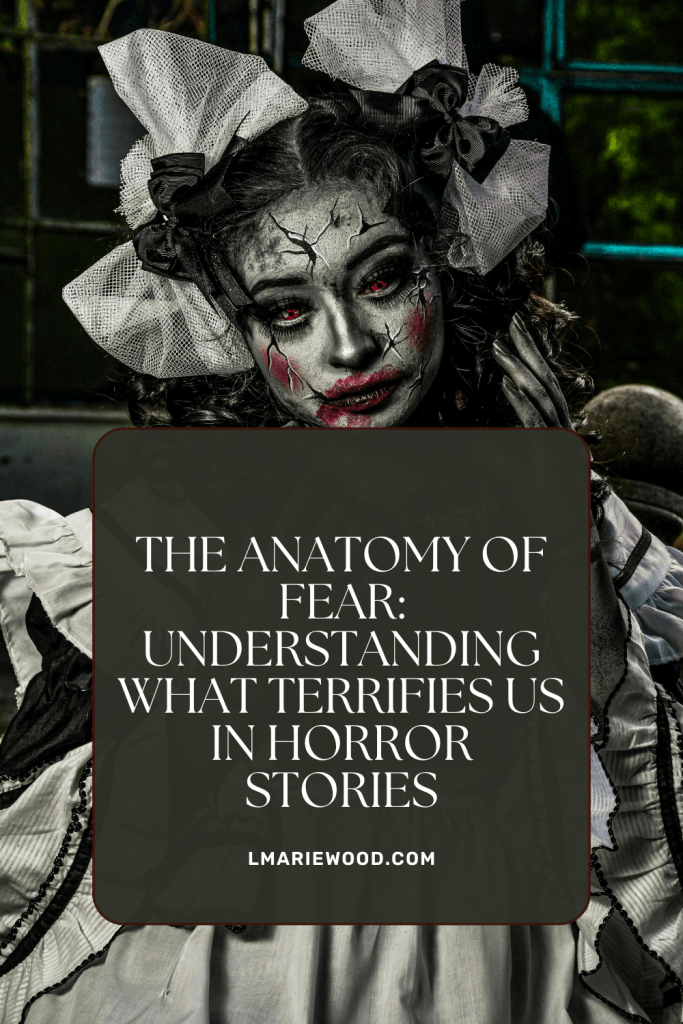
Horror stories captivate by tapping into the primal emotion of fear, an essential survival mechanism alerting us to danger. This article explores the elements that make horror stories frightening, drawing on psychological insights, storytelling techniques, and cultural analyses.
Understanding Fear
Fear is a fundamental human emotion, crucial for survival. It triggers the body’s fight-or-flight response, preparing us to confront or flee from perceived threats. Scholarly work in psychology, such as that by LeDoux (1996), highlights the amygdala’s role in processing fear, emphasizing the emotion’s deep evolutionary roots. LeDoux’s exploration of the brain mechanisms behind fear response underscores why horror stories resonate so deeply; they simulate scenarios that activate these ingrained responses, allowing us to experience fear in a controlled, safe environment.
Elements of Horror in Literature and Film
Settings in horror stories, like the isolated Overlook Hotel in Stephen King’s The Shining, amplify fear by creating a sense of vulnerability and isolation. King, in his non-fiction work Danse Macabre (1981), discusses how horror taps into the universal dread of the unknown and the unseen. Characters in horror narratives, from Bram Stoker’s Dracula to the anonymous entities in modern horror, embody our deepest fears: death, the unknown, and loss of control. Stoker’s novel, for instance, plays on fears of the exotic and the uncanny, themes that Freud (1919) explored in his seminal essay “The Uncanny,” where familiar things become distressingly alien.
The plot and themes in horror stories often explore existential fears. Noel Carroll, in The Philosophy of Horror (1990), argues that horror confronts us with entities that defy our understanding of the natural world, challenging our sense of order and prompting a confrontation with the unknown. Similarly, the use of sound and visuals in horror films, as noted by Clover (1992) in Men, Women, and Chain Saws, manipulates the viewer’s emotions, using dissonant sounds and shadowy visuals to create an atmosphere of tension and fear.
Psychological Techniques in Horror Storytelling
The power of the imagination is a crucial tool in horror. As Todorov (1975) suggests in The Fantastic, the ambiguity between the supernatural and the psychological in horror stories forces readers to confront their own beliefs about reality, engaging their fears more deeply. This engagement is further intensified by the mechanism of empathy, where, as Murray Smith (1995) posits in Engaging Characters, identification with characters in peril allows audiences to vicariously experience fear and suspense.
Cultural and Societal Influences on Horror
Horror stories reflect societal fears and anxieties, acting as a mirror to the collective unconscious. As Jancovich (1992) argues, horror films in the 1950s reflected Cold War anxieties, while contemporary horror often incorporates fears of technology and pandemic. This reflects how horror evolves with societal changes, tapping into current anxieties to evoke fear.
The Cathartic Effect of Horror Stories
Aristotle’s notion of catharsis applies to the horror genre, where experiencing fear through fiction provides a release of pent-up emotions, a concept supported by the work of scholars like Clasen (2017) in Why Horror Seduces. This catharsis, coupled with the thrill of the fight-or-flight response in a safe context, explains the enduring appeal of horror.
The anatomy of fear in horror stories is a complex interplay of psychology, culture, and artistry. By engaging with our primal fears in a controlled environment, horror stories allow us to confront the unknown, providing a space for catharsis and exploration. Through the lens of scholarly analysis, it becomes clear that our fascination with horror is deeply rooted in our desire to understand and master our fears.
References:
- Carroll, N. (1990). The Philosophy of Horror or Paradoxes of the Heart. Routledge.
- Clasen, M. (2017). Why Horror Seduces. Oxford University Press.
- Clover, C. J. (1992). Men, Women, and Chain Saws: Gender in the Modern Horror Film. Princeton University Press.
- Freud, S. (1919). “The Uncanny”. In The Standard Edition of the Complete Psychological Works of Sigmund Freud, Volume XVII. Hogarth Press.
- Jancovich, M. (1992). Horror. B.T. Batsford Ltd.
- King, S. (1981). Danse Macabre. Everest House.
- LeDoux, J. (1996). The Emotional Brain: The Mysterious Underpinnings of Emotional Life. Simon & Schuster.
- Smith, M. (1995). Engaging Characters: Fiction, Emotion, and the Cinema. Oxford University Press.
- Stoker, B. (1897). Dracula. Archibald Constable and Company.
- Todorov, T. (1975). The Fantastic: A Structural Approach to a Literary Genre. Cornell University Press.
 L. Marie Wood