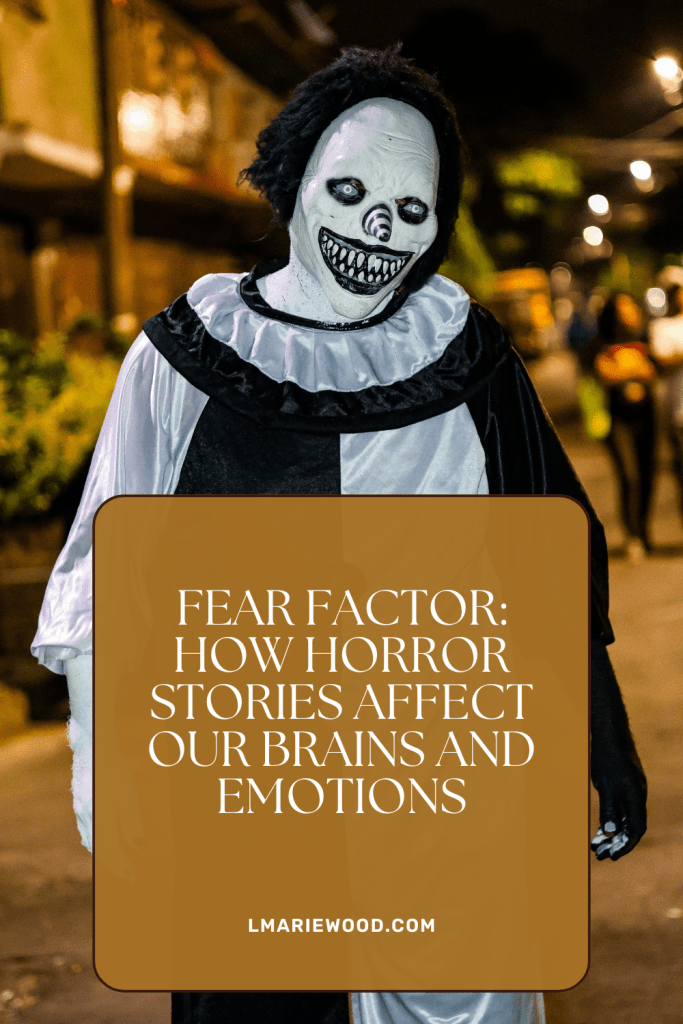
Have you ever curled up with a horror novel, heart pounding, jumping at every little noise in your house, yet you couldn’t put the book down? Or maybe you’ve binged through a horror series, feeling both terrified and utterly captivated. Ever wonder what’s going on in your noggin during those intense moments of fear and fascination? Let’s dive into the eerie world of how horror stories mess with our brains and tug at our emotions, shall we?
The Brain on Horror
First up, let’s talk about your brain, that beautiful blob of gray matter that loves to freak you out. When you’re absorbed in a horror story, your amygdala (let’s call it the fear center of the brain) kicks into high gear. It’s like the amygdala is at a rock concert, lighting up with activity. This response triggers a cascade of physical reactions: increased heart rate, higher blood pressure, and that oh-so-familiar adrenaline rush. It’s the body’s way of prepping you to either fight for your life or run like the wind.
The Thrill of the Scare
But why do we keep coming back for more, you ask? Well, there’s something oddly satisfying about being scared in a safe environment. This controlled scare allows us to experience and process fear on our terms, which can be exhilarating. It’s like riding a roller coaster; we enjoy the thrill because we know, deep down, we’re actually safe. This phenomenon is linked to the concept of “vicarious risk-taking.” Reading about characters facing unspeakable horrors or navigating through a haunted house lets us explore our fears without real-world consequences.
Empathy and the Horror Connection
Here’s where it gets interesting. When we dive into horror stories, we’re not just passive observers; we often empathize with the characters. We feel their fear, their desperation, and their will to survive. This empathy activates parts of our brain associated with social understanding and emotional processing. It’s a bit of a mental workout, really, enhancing our ability to connect with and understand others’ emotions.
The Catharsis Theory
Aristotle was onto something when he talked about catharsis—the idea that experiencing fear and pity through art purges these emotions, leaving us feeling refreshed. Horror stories can serve as a form of emotional release. They allow us to confront our darkest fears, scream (either internally or literally), and then, crucially, close the book or turn off the TV. We’ve faced the abyss, and hey, we’re still here.
Nightmares and Neural Pathways
Ever had a nightmare after a horror story binge? That’s your brain processing what you’ve fed it. While not always pleasant, this can strengthen our coping mechanisms. Each scare, each nightmare, is an opportunity for our brains to practice dealing with fear in a controlled setting, potentially making us more resilient to real-life stressors.
Horror: Not Just for Halloween
Horror stories aren’t just for Halloween—they’re a year-round invitation to explore the human psyche, to understand what scares us and why. They remind us of our vulnerability, yes, but also of our incredible capacity to face fear and prevail.
References
- Zillmann, D. (1996). The psychology of suspense in dramatic exposition. In P. Vorderer, H. J. Wulff, & M. Friedrichsen (Eds.), Suspense: Conceptualizations, theoretical analyses, and empirical explorations. Lawrence Erlbaum Associates, Inc.
- Mar, R. A., Oatley, K., Hirsh, J., dela Paz, J., & Peterson, J. B. (2006). Bookworms versus nerds: Exposure to fiction versus non-fiction, divergent associations with social ability, and the simulation of fictional social worlds. Journal of Research in Personality, 40(5), 694-712.
- Andrade, E. B., & Cohen, J. B. (2007). On the Consumption of Negative Feelings. Journal of Consumer Research, 34(3), 283-300.
- Harris, S. (2010). The Moral Landscape: How Science Can Determine Human Values. Free Press. (For insights into brain function and morality/empathy.)
- Kerr, M., Siegle, G. J., & Orsini, J. (2009). Voluntary arousing negative experiences (VANE): Why we like to be scared. Emotion, 9(5), 682-695.
- Scrivner, C., Johnson, J. A., Kjeldgaard-Christiansen, J., & Clasen, M. (2020). Pandemic practice: Horror fans and morbidly curious individuals are more psychologically resilient during the COVID-19 pandemic. Personality and Individual Differences, 168, 110397.
 L. Marie Wood