Sheesh! Time is moving FAST these days! May is almost over. I’m ready for the warmer weather, but I’m not loving how quickly things seem to be moving. SMH.
How’ve you been?
Me? Things have been good. REALLY good, actually. This kind of good:
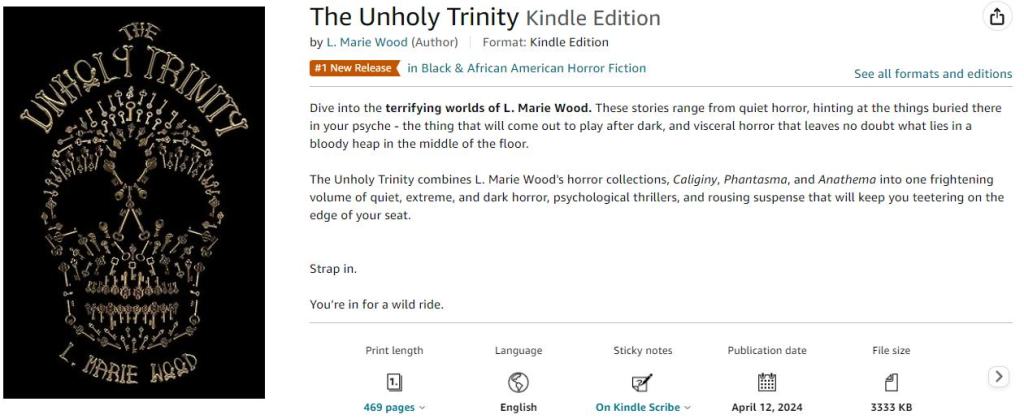
YAHOOOO!!!!!
So excited to see this beauty earn an orange banner! If you haven’t read The Unholy Trinity yet, you definitely should make space on your TBR stack for it. 99 stories of terror? Yes, please!

I’m excited to be part of this non-fiction work. The title alone is just straight up creepy. Sometimes it’s fun to think deeply and write profuesely. 🙂 If you like academic writing from a horror perspective, check this out!
Stuff’s coming – some magazines, some books, some stories – but I’ll talk about those in another newsletter (ha!). For now, let’s talk about psychological horror (my favorite topic) vs. gore. This is the age-old debate among horror enthusiasts: What really sends those shivers down our spines? Is it the gruesome sight of gore, or the subtle, creeping dread of psychological horror? Let’s dive into this discussion with a flashlight in one hand and a protective blanket in the other because, let’s face it, we might need both by the end of this.
The Gory Details
Gore horror, or splatter horror as it’s sometimes lovingly called, relies heavily on explicit portrayals of violence, bloodshed, and visceral terror. Think classic slashers like Friday the 13th or the stomach-churning scenes of Saw. These films make no apologies for their graphic content, aiming to shock and appall their audience with a visual feast of the macabre.
The appeal? It’s straightforward. Gore horror taps into our primal disgust and fear of bodily harm. It’s in-your-face, it’s bloody, and for many, it’s thrilling. The adrenaline rush from witnessing these cinematic spectacles can be akin to riding a roller coaster — scary, yet exhilarating.
Mind Games
On the other side of the eerie spectrum lies psychological horror, a genre that prefers to play long games of chess with your mind. Films and books in this category, such as The Shining or Hereditary, rely on atmosphere, suspense, and the unknown to elicit fear. It’s less about what you see and more about what you don’t see — the things that lurk in the shadows or, even worse, in the depths of the human psyche.
Psychological horror challenges our perceptions and plays on our deepest fears, often leaving a lasting impression long after the initial experience. It’s the slow burn, the creeping dread that something is not quite right, that perhaps the real monsters are in our heads.
So, what scares us more?
The debate boils down to personal preference and, perhaps, what we’re afraid of on a deeper level. Gore horror confronts us with the undeniable fragility of our bodies, a visceral reminder of our mortality. Psychological horror, however, confronts us with the fragility of our minds, tapping into fears that are more abstract and often more personal.
Studies in the field of psychology suggest that fear responses are highly individual,
shaped by personal experiences, cultural background, and even biology. For instance, a study by Andrade and Cohen (2007) found that different people have different thresholds for disgust and fear, influencing their reactions to horror.
The Verdict
Is one genre superior to the other in terms of its ability to scare? Not necessarily. Both gore and psychological horror have their place in the pantheon of terror, each serving to scare in its unique way. The real question might be what you’re in the mood for — a visceral shock to the system or a haunting journey into the depths of fear itself?
In the end, whether you prefer your horror soaked in blood or steeped in suspense, the world of horror offers something for every taste. So, the next time you’re deciding between a gory slasher or a psychological thriller for movie night, remember: the best choice is the one that gets your heart racing.
This playful foray into the debate between psychological horror and gore offers a
glimpse into the diverse tapestry of horror and what makes our hearts beat faster in the dark. Whether you lean towards the gore that shocks your senses or the psychological narratives that unsettle your mind, the essence of horror remains the same: to confront the unknown, the fearful, and the profoundly unsettling aspects of life and imagination.
References
● Andrade, E. B., & Cohen, J. B. (2007). On the Consumption of Negative Feelings.
Journal of Consumer Research, 34(3), 283-300.
● Carroll, N. (1990). The Philosophy of Horror or Paradoxes of the Heart. Routledge.
An exploration of why people are drawn to horror films.
● King, S. (1981). Danse Macabre. Everest House. Stephen King’s analysis of the
horror genre in literature and film.
● Skal, D. J. (1993). The Monster Show: A Cultural History of Horror. Penguin Books.
A comprehensive history of the horror genre from a cultural perspective.
Let’s see – what else? Oh! Con season! I’ll be at Balticon virtually this year on a few interesting panels, and both in person and virtually at StokerCon. If you are going to either of those, see you there!
Until next time,
L. Marie
 L. Marie Wood